
Your water can look clear and still be unsafe. Lead, nitrate, PFAS, and bacteria are colorless, odorless, and tasteless. They have no taste. They have no smell. So you cannot judge your water by looking at it.
About 43 million Americans drink from private wells. No agency tests that water for them. City water is tested, but the utility tests it at the plant. It does not test the water at your kitchen sink.
This guide shows you how to test your home's water quality. You will learn what to test for, whether a home water testing kit is enough, how to collect a good sample, and how to read your results.
Key Takeaways
- A certified laboratory water analysis is the only way to check for lead, bacteria, PFAS, and arsenic. Cost: about $100 to $300.
- DIY water test strips check chlorine, pH, and hardness in about one minute. Cost: about $15 to $50.
- A TDS meter reads total dissolved solids in seconds. Cost: about $10 to $30. It cannot name a single contaminant.
- Strips and TDS meters do not detect lead. For lead, you need a lab.
- Well owners should test for bacteria and nitrates every year.
Why Testing Your Home's Water Matters
Clean water protects your family. Testing shows you whether your water is clean. It is also the only way to pick the right filter.
What Your Utility's Report Does Not Tell You
Every city water system sends out a Consumer Confidence Report (CCR) each year. Some call it the annual water quality report. It lists what the utility found in the water supply.
That report is useful. But it has a gap. The utility tests the water it sends out. It does not test the water that comes out of your tap.
Water picks things up on the way to your house. A lead service line can add lead. Old pipes can add metals. Copper corrosion byproducts can form inside your own plumbing. None of that shows up in the city report.
City Water Versus Private Well Water
These two water sources carry different risks.
Federal rules cover municipal water supplies. The Safe Drinking Water Act (SDWA) sets limits for more than 90 contaminants. Public water system oversight means the utility must test, treat, and report.
Private well water testing is different. Federal rules do not cover private wells. Private well owners are responsible. If fertilizer or a bad septic tank reaches your well, no one will call you.
It also helps to know where your water starts. Groundwater versus surface water matters. Groundwater picks up minerals and metals from rock. Surface water picks up runoff from land.
The Rules Behind Your Water
A few rules shape what gets tested and reported. You do not need to memorize them. It helps to know they exist.
- National Primary Drinking Water Regulations (NPDWR): legal limits for public water systems.
- Consumer Confidence Report Rule: requires your yearly report.
- Revised Total Coliform Rule: sets how systems test for bacteria.
- Lead and Copper Rule Improvements (LCRI): the 2024 rule on lead service lines.
- PFAS National Primary Drinking Water Regulation: the 2024 PFAS limits, now under review.
- Contaminant Candidate List (CCL 6): chemicals the EPA may regulate next.
- Unregulated Contaminant Monitoring Rule (UCMR 5): collects data on chemicals with no limit yet.
- Safe Drinking Water Information System (SDWIS): the EPA database of system violations.
- Bipartisan Infrastructure Law lead service line funding: money for cities to remove lead pipes.
Safe Drinking Water Act compliance applies only to public systems. Well owners must fill that gap themselves.
Who Should Test Right Away
Test soon if any of these apply to you:
- Someone in the home is pregnant or nursing.
- A baby or a young child lives in the home.
- An older adult or a sick person lives in the home.
- Your house was built before 1986, when lead-soldered plumbing was still legal.
- You have galvanized steel pipes.
- You drink from a private well and have never tested it.
Signs You Should Test Your Water Right Now
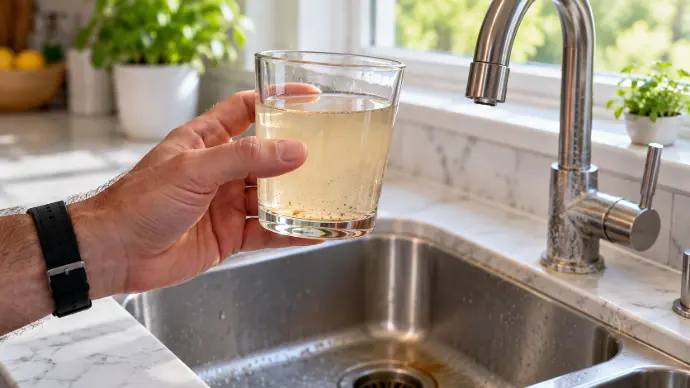
Some problems do give you a clue. Use this table to match what you notice with a likely cause.
What you notice | Likely cause |
Rotten egg smell in water | Hydrogen sulfide gas or sulfur bacteria |
Metallic taste in tap water | Lead, copper, iron, or zinc |
Rust colored water stains | Iron or iron bacteria |
Blue-green staining on fixtures | Copper from pipe corrosion |
White limescale buildup | Hard water minerals |
Cloudy or milky tap water | Trapped air or high turbidity |
Chlorine taste and odor | Chlorine or chloramine levels |
Soap scum and film | Calcium and magnesium hardness |
Water discoloration after plumbing work | Loose rust, sediment, or metal |
Unexplained gastrointestinal illness | Bacteria or parasites |
Test Now, Not Next Year
Some events mean you should test right away. Do not wait for your normal date.
- Flooding or heavy rain near your well
- Any well repair or new well parts
- A new baby in the home
- A spill, a new farm, or drilling nearby
- Any sudden change in taste, smell, or color
- New plumbing or a new water heater
What to Test For, Based on Your Water Source
You do not need every test. You need the right tests. Your water source and your region decide the list.
If You Have City Water
Start with what your own pipes can add, plus what treatment can leave behind.
- Lead in drinking water
- Copper
- Free chlorine versus total chlorine
- Trihalomethanes (TTHMs) and haloacetic acids (HAA5), both disinfection byproducts
- PFAS, forever chemicals, mainly PFOA and PFOS
If You Have a Well
The EPA advises private well owners to test each year for total coliform bacteria, nitrates, total dissolved solids (TDS), and drinking water pH.
Add a wider panel every three to five years:
- Arsenic in well water
- Radon in water
- Uranium in groundwater
- Manganese in water
- Volatile organic compounds (VOCs)
- Fluoride levels in tap water
Region and Land Use Add-Ons
Your local area changes the list. Ask your health department what is common near you.
- Farm areas: nitrate from agricultural fertilizer and pesticide and herbicide runoff
- Industry or gas stations nearby: VOCs and fuel chemicals
- Certain rock types: arsenic, radon, uranium, hexavalent chromium (chromium-6)
- Old buildings: asbestos fibers in water and mercury contamination
Master Contaminant Table
Contaminant | Common source | Health concern | EPA limit | Can a DIY kit find it? |
Lead | Lead pipes, solder, brass | Brain and nerve harm in kids | 15 ppb action level | No |
Copper | Pipe corrosion | Stomach upset, liver harm | 1.3 ppm action level | Some |
Nitrate contamination | Fertilizer, septic waste | Blue baby syndrome | 10 mg/L | Some |
Nitrite levels | Septic waste, sewage | Same as nitrate | 1 mg/L | Some |
Total coliform | Surface water entering a well | Warning sign for germs | 0 | Some |
E. coli in drinking water | Human or animal waste | Serious stomach illness | 0 | Some |
Fecal coliform | Waste contamination | Stomach illness | 0 | Some |
Arsenic | Natural rock | Cancer, skin damage | 10 ppb | No |
PFAS | Firefighting foam, factories | Cancer, immune harm | 4 ppt for PFOA and PFOS | No |
VOCs | Fuel, solvents, dry cleaning | Liver and cancer risk | Varies | No |
TTHMs | Chlorine plus organic matter | Cancer risk | 80 ppb | No |
Haloacetic acids | Chlorine plus organic matter | Cancer risk | 60 ppb | No |
Radon | Natural rock | Lung cancer | No federal limit yet | No |
Uranium | Natural rock | Kidney damage | 30 ppb | No |
Chromium-6 | Industry, natural rock | Cancer risk | Covered by total chromium | No |
Manganese | Natural rock | Nerve effects in babies | 0.05 mg/L guideline | No |
Hydrogen sulfide gas | Sulfur bacteria | Bad smell, taste | None | Smell test only |
Cryptosporidium and Giardia cysts | Animal or human waste | Diarrhea illness | Treatment rule | No |
Asbestos | Old cement pipe | Stomach growths | 7 million fibers per liter | No |
Mercury | Industry, natural rock | Kidney damage | 2 ppb | No |
How Often Should You Test?
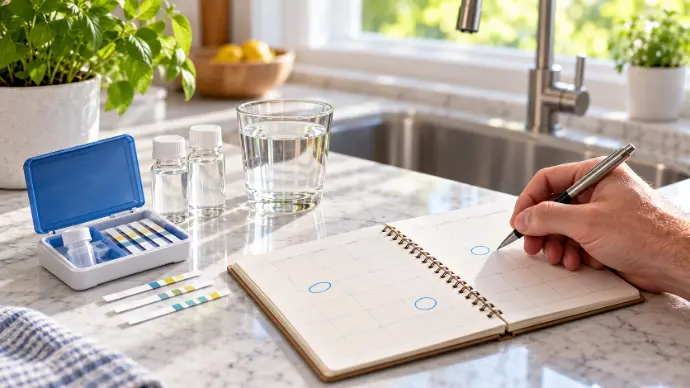
Both the Centers for Disease Control and Prevention (CDC) and the U.S. Environmental Protection Agency (EPA) recommend testing a private well for bacteria and nitrates at least once a year.
Here is a simple annual water testing schedule.
How often | What to test |
Every year | Coliform bacteria, E. coli, nitrate, TDS, pH |
Every 3 to 5 years | Arsenic, lead, copper, fluoride, radon, VOCs, metals |
Right away | After flooding, repair, a new baby, or any change you notice |
City water, every 2 to 3 years | Lead at the tap, plus PFAS if it is a local concern |
Test more often if you have a shallow well, an old well, or a baby at home. Maine's health department recommends testing for coliform bacteria, E. coli, nitrates, and nitrites yearly, with a broader panel every three to five years.
So how often should you test well water? At least once a year.
The Main Ways to Test Water at Home
There are four paths. Each one has a job. Picking the wrong one wastes money.
Method | What it finds | How accurate | Cost | Time |
Test strips | Chlorine, pH, hardness, some nitrate | Rough | $15 to $50 | 1 minute |
TDS meter | Total dissolved solids only | Exact for TDS | $10 to $30 | Seconds |
Mail-in lab kit | Metals, bacteria, PFAS, VOCs | Very high | $100 to $300 | 5 to 10 days |
In-home pro test | Hardness, iron, TDS, basics | Medium | Often free | Same visit |
DIY Water Test Strips
DIY water test strips are the cheapest start. You dip a strip in a glass of water. You wait 30 to 60 seconds. Then you match the color to a chart.
Strips work well for quick chlorine residual tests, alkalinity tests, and water hardness (grains per gallon). They are good for checking your softener between lab tests.
Strips have real limits. They cannot measure down to the parts per billion (ppb) range. That is the range where heavy metals cause harm. So strips cannot rule out lead, arsenic, or PFAS.
TDS Meters
A TDS meter reading in ppm tells you how many dissolved solids are in your water. Minerals, salts, and metals all add to that number.
This helps you track a reverse osmosis system. If the number climbs, the membrane may be worn out. An electrical conductivity meter works on the same idea.
Here is the key point. A low TDS number is not a safety score. Lead can sit in your water at a dangerous level while TDS reads low.
Certified Laboratory Testing
A certified laboratory water analysis is the gold standard. You get a mail-in water test kit with sterile sample bottles. You collect the sample, ship it back, and get a full report.
Labs use tools like ICP-MS and GC-MS. These can detect trace amounts at parts-per-billion levels or lower. No home kit can match that.
A lab test is the right call if you are pregnant, you have a new baby, your well water has changed, or someone has been sick with no clear cause.
Professional In-Home Testing
Many water treatment companies offer a free professional in-home test. A technician visits and runs quick checks. You get answers on the spot.
This is handy for hardness and iron. Remember, the company also sells treatment systems. For health questions, back it up with a lab test.
How to Choose a Certified Lab

Not every lab can test for every contaminant. Laboratory accreditation is granted test by test.
Here is what to do:
- Check for state certification. Ask your state-certified water testing lab if it is approved for the exact tests you need.
- Use the EPA directory. The EPA keeps a list of EPA-certified drinking water laboratories you can search by state.
- Call your health department first. Many state labs are the cheapest choice. Indiana's state lab, for example, charges about $10 for a bacteria test and $10 for nitrate.
- Try a mail-in service. Options like SimpleLab Tap Score, National Testing Laboratories (WaterCheck), and kits from Safe Home, Health Metric, LaMotte, and Hach ship the bottles to you.
The Massachusetts Department of Environmental Protection (MassDEP) explains why this matters. A certified lab has proven it can produce valid data using EPA-approved methods.
How to Collect a Water Sample the Right Way
A bad sample gives a bad result. Your lab's water sample collection procedure is the one you should follow. These steps cover the common rules.
- Read the lab's sheet first. Every lab has its own rules. The lab's rules take precedence over any guide, including this one.
- Pick the right tap. Use the tap you drink from most. Skip any tap with a filter on it unless you want to test the filter.
- Know which sample you need. Take a first-draw sample after the water has sat still for at least six hours. This is the standard for lead, since metal builds up in still water. Take a flushed sample after running the tap for a few minutes. That shows what comes from the main line.
- Handle the aerator as told. Some labs want it removed. Some want it left on. Do not guess.
- Do not touch the inside of the bottle. Do not touch the inside of the cap either. Your hands carry bacteria.
- Do not rinse a preserved bottle. Some bottles hold powder or liquid on purpose. Rinsing ruins the test.
- Fill in the line. Cap it tight.
- Fill out the paperwork. The chain-of-custody form tracks your sample. Labs reject samples without it.
- Keep it cold and ship fast. Bacteria samples are time-sensitive. They must reach the lab within 24-48 hours.
Five Mistakes That Ruin Results
- Running the tap before a first-draw lead test
- Touching the bottle rim with your fingers
- Shipping a bacteria sample on a Friday
- Letting the sample sit warm in a car
- Sampling from a hose or an outdoor spigot
How to Read a Water Test Report
Your report will be full of numbers and short codes. Here is the plain meaning.
Units You Will See
- Parts per million (ppm) is the same as milligrams per liter (mg/L).
- Parts per billion (ppb) is the same as micrograms per liter (µg/L).
- Parts per trillion (ppt) is much smaller still. PFAS is measured this way. Four ppt is about four drops in 20 Olympic pools.
- Turbidity measurement (NTU) shows how cloudy water is.
What the Limits Mean
- Maximum contaminant level (MCL): the legal limit for public water.
- Maximum contaminant level goal (MCLG): the ideal level with no known health risk. It is a goal, not a law.
- EPA action level for lead (15 ppb): the point where a utility must take steps.
- Secondary drinking water standards: guidelines for taste, color, and stains. These are not health rules.
- Method detection limit: the smallest amount the lab can find. "Not detected" means below this line, not zero.
Benchmark Table
Test | Safe range or limit |
Lead | Below 15 ppb (goal is zero) |
E. coli | 0 |
Nitrate | Below 10 mg/L |
Arsenic | Below 10 ppb |
pH | 6.5 to 8.5 |
TDS | Below 500 mg/L |
Hardness | Above 60 mg/L is moderately hard |
Sulfate concentration | Below 250 mg/L |
Fluoride | Below 4.0 mg/L |
Sodium content in softened water | Watch it on a low-salt diet |
When a Number Is Too High
An exceedance means a result is above the limit. That triggers corrective action. Do not drink the water until you treat it or switch to another supply.
One more thing about how to read a water test report. Lead results change by time of day. Water that sat in your pipes overnight tests higher than water at noon. Two neighbors can get very different lead numbers, and both can be right.
Testing for PFAS, Lead, Bacteria, and Special Cases
PFAS
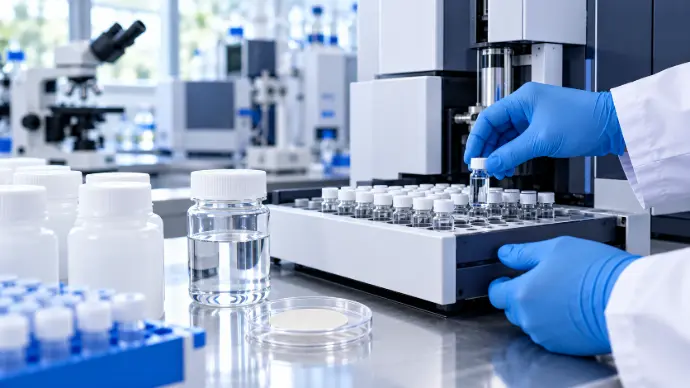
No strip and no meter can find PFAS. You need a certified lab using EPA Method 537.1 or EPA Method 533. These methods measure at the parts-per-trillion level.
The rules here are changing. On May 18, 2026, the EPA proposed two rules. One keeps the 4 ppt limits for PFOA and PFOS but lets systems ask for two more years, moving the deadline from 2029 to 2031. The other would remove the limits for PFHxS, PFNA, PFBS, and HFPO-DA (GenX), plus the hazard index for mixtures.
Groups like the Natural Resources Defense Council (NRDC) and the American Water Works Association (AWWA) are active in court cases over these rules. Check the EPA site for the current status before you act on any number.
Lead
Use a first-draw sample. Labs often run EPA Method 200.8 for metals.
Also check your service line. Scratch the pipe where it enters your home. If it is soft, dull gray, and a magnet does not stick, it may be lead. The 2024 Lead and Copper Rule Improvements (LCRI) would require replacing nearly all lead service lines within 10 years.
Bacteria
Labs often use Standard Method 9223B (Colilert). Total coliform is a warning flag. It suggests a path exists for germs to enter. Escherichia coli confirms waste contamination. Legionella pneumophila and Cryptosporidium parvum need their own tests.
Check your well cap and septic system setback too. A cracked cap lets surface water in.
For nitrate, sulfate, and fluoride, labs often run EPA Method 300.0, which measures common ions.
Radon and VOCs
Radon-222 and VOCs escape into the air fast. These samples need special sealed bottles with no air bubbles. Follow the lab's steps closely.
What to Do If Your Results Are Bad
Match the fix to the problem. No single filter handles everything.
Result | What to do |
Bacteria present | Run a shock chlorination of a well, retest, then add a UV disinfection system |
High lead | Use an NSF/ANSI 53 filter or RO, flush before drinking, replace the line |
High nitrate | Use RO or ion exchange. Boiling makes nitrate worse, not better |
Hard water | Install an ion exchange water softener |
PFAS found | Use RO or an activated carbon filter certified for those compounds |
Bad taste or smell | Use activated carbon |
Iron or sulfur | Use oxidation plus filtration |
Many issues | Consider a whole-house filtration system |
Point of Entry Versus Point of Use
Point-of-entry versus point-of-use is a simple choice. The point of entry treats all the water in the house. Point-of-use treats one tap, often the kitchen sink.
Check the Certification
Always pick an NSF-certified water filter. But read the fine print. Certification is given contaminant by contaminant. A product can be certified under NSF/ANSI 53 for arsenic and still not be certified for lead.
Here are the standards that matter most:
- NSF/ANSI 42: taste, odor, and chlorine
- NSF/ANSI 53: health effects, such as lead, chromium, and VOCs
- NSF/ANSI 58: reverse osmosis systems
- NSF/ANSI 55: UV systems
- NSF/ANSI 401: emerging contaminants
- NSF/ANSI 44: cation exchange water softeners
- NSF/ANSI 61 and 372: safe materials and lead-free parts
- NSF P231 and P473: microbes and select PFAS claims
NSF International is the best-known certifier. It works with the American National Standards Institute (ANSI). Two other groups test to the same standards. The Water Quality Association (WQA) Gold Seal program is fully accredited. IAPMO R&T also certifies drinking water treatment devices. All three are trustworthy when they name the same standard number.
Brands such as Brita, PUR, Culligan, and Aquasana carry these marks on many models. Check the listing for your exact model, not just the brand.
How Much Does Water Testing Cost?
Water testing costs depend on how deep you go.
Option | Typical cost |
Test strips | $15 to $50 |
TDS meter | $10 to $30 |
Basic bacteria and nitrate test | $25 to $75 |
Standard lab panel | $100 to $300 |
Full panel with PFAS | $400 to $800 |
For most homes, a basic yearly test plus a wide panel every three years costs about $150 to $250 per year. Many county health departments offer free or low-cost basic testing, so ask first.
Frequently Asked Questions
Can I test my water quality at home?
Yes. Strips and TDS meters give quick answers about chlorine, pH, hardness, and dissolved solids. For lead, bacteria, arsenic, or PFAS, you need a lab.
Are water test strips accurate?
They are accurate enough for rough checks. They cannot measure parts per billion, so they cannot confirm that your water is safe.
Does boiling water remove contaminants?
Boiling kills bacteria and parasites. It does not remove lead, arsenic, or PFAS. Boiling actually raises nitrate levels, since water evaporates and the nitrate stays.
How do I get my Consumer Confidence Report?
Check your water utility's website. You can also search the EPA database or call the number on your water bill.
Can a TDS meter detect lead?
No. A TDS meter gives one total number. It cannot tell one substance from another.
Does a Brita filter remove lead or PFAS?
Some models do; others do not. Look for the model's NSF/ANSI 53 or 58 listing and check the exact contaminants named.
How long do water test results take?
Most labs send a report in 5 to 10 business days. Bacteria results can come back in about 48 hours.
Is bottled water tested more than tap water?
No. Bottled water is regulated as a food product. Public tap water is tested often, and the results are public.